
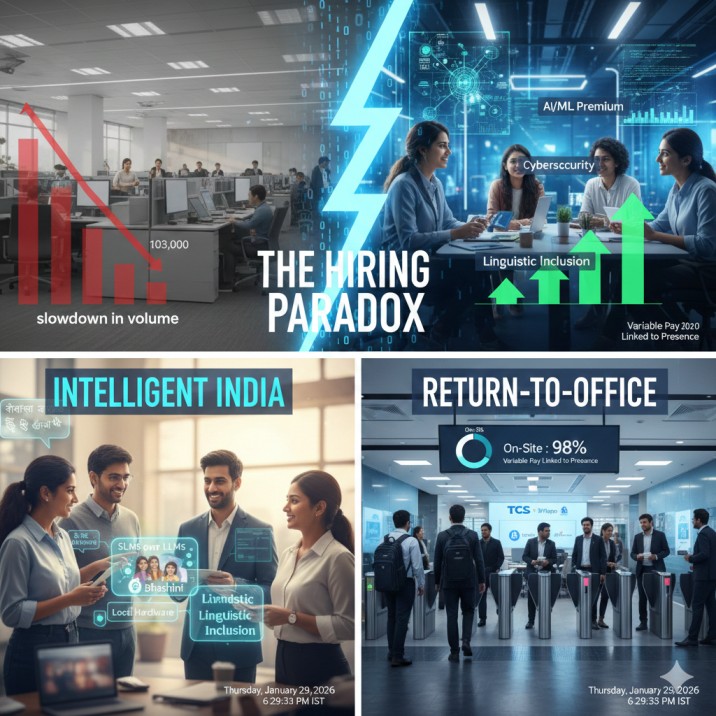
The Indian IT sector, a powerhouse of global innovation and talent, finds itself at a fascinating crossroads in early 2026. While headlines might hint at a slowdown, the reality on the ground is far more nuanced, presenting what industry experts are terming “The Hiring Paradox.” This isn’t your typical boom-and-bust cycle; instead, it’s a strategic recalibration driven by the inexorable rise of Artificial Intelligence (AI) and a shift towards specialized, high-value skills. For job seekers, companies, and stakeholders alike, understanding this paradox is crucial to thriving in the evolving landscape.
Decoding the Dual Reality: Caution Meets Opportunity
On one hand, there’s an undeniable air of caution. The hyper-growth phase of the past few years, characterized by mass hiring across all levels, has tapered off. Active tech job openings in January 2026 have dipped to approximately 103,000, marking a 24% year-on-year decline. This figure, while significant, doesn’t tell the whole story. It reflects a shift away from volume-based recruitment towards a more targeted, skill-centric approach.
On the other hand, a vibrant undercurrent of opportunity is pulsating through the sector, particularly for those with specialized skills. Technology continues to reign as the top paymaster, with roles in cutting-edge domains commanding unprecedented salaries. This dichotomy is the essence of the Hiring Paradox: a contraction in the sheer number of available positions, juxtaposed with an explosion in demand and compensation for niche expertise.
The AI Premium: Where the Real Value Lies
The most significant driver of this paradox is the relentless march of AI. India’s IT industry is aggressively pivoting towards an “AI-first” model, which means a fundamental re-evaluation of required skill sets. This isn’t just about integrating AI tools; it’s about embedding AI thinking into every facet of development, operations, and business strategy.
This paradigm shift has created an “AI Premium” on talent. Roles such as:
-
AI/ML Engineers: Experts in machine learning algorithms, deep learning, and neural networks are at the forefront of this demand.
-
Data Scientists: Professionals who can extract actionable insights from vast datasets, crucial for training and refining AI models.
-
Prompt Engineers: A relatively new but rapidly growing role, focusing on optimizing inputs for generative AI models to achieve desired outputs.
-
Cybersecurity Specialists: With AI adoption comes an increased attack surface, making robust cybersecurity more critical than ever.
-
Cloud Architects: Designing and managing scalable cloud infrastructure to support AI workloads is paramount.
These specialists are not just finding jobs; they are dictating terms, with senior-level compensation in Tier-2 cities now impressively rivaling those in traditional Tier-1 metros like Bengaluru and Hyderabad. Companies are willing to invest heavily in talent that can drive their AI transformation, recognizing that future competitiveness hinges on this expertise.
The Rise of Global Capability Centers (GCCs): A Beacon of Growth
Amidst the broader hiring recalibration, Global Capability Centers (GCCs) stand out as a significant growth engine. These offshore units of multinational corporations are experiencing a robust expansion, growing by 7% year-on-year. Giants like Google, Amazon, Microsoft, and others are deepening their roots in India, transforming their GCCs from mere cost centers into true innovation hubs.
Why the surge in GCCs?
-
Access to Specialized Talent: India’s vast pool of STEM graduates, increasingly skilled in AI and emerging technologies, makes it an attractive destination.
-
Innovation Mandate: Many GCCs are now tasked with product development, R&D, and global solutioning, requiring highly skilled engineers and researchers.
-
Strategic Importance: As global companies navigate geopolitical shifts and supply chain complexities, India’s strategic importance as a stable talent hub continues to grow.
The sustained growth of GCCs is not just about job creation; it’s about bringing high-value, cutting-edge work to India, further solidifying its position as a global technology leader.
Layoffs and Restructuring: The Skill Mismatch Challenge
The early months of 2026 have also seen a continuation of layoffs across the tech sector, both globally and within India. Companies like Amazon have announced global workforce reductions, impacting their AWS operations in India, while Indian stalwarts like TCS are undertaking targeted workforce rationalization. TCS, for instance, is continuing a workforce reduction of approximately 2% (around 12,000 jobs), primarily targeting middle and senior management layers to streamline operations and enhance agility.
It’s critical to understand the nature of these layoffs. They are largely not a symptom of economic collapse or a lack of business. Instead, they represent a “skill-based restructuring.” The skills that were highly valued a few years ago might be less relevant in an AI-driven environment. Companies are making difficult but strategic decisions to:
-
Flatten organizational structures: Reducing layers of management to improve decision-making and efficiency.
-
Reallocate resources: Freeing up capital and talent from legacy operations to invest in AI research, development, and deployment.
-
Address skill gaps: Letting go of individuals whose skills no longer align with future strategic objectives, while simultaneously hiring for AI-centric roles.
This highlights a significant skill mismatch in the industry. While there’s a surplus of talent with conventional IT skills, there’s a pronounced deficit in specialized AI, ML, data science, and cybersecurity expertise. This necessitates a proactive approach from both individuals and educational institutions to reskill and upskill.
The Return-to-Office Mandate: A New Era of Workplace Norms
Adding another layer to the evolving landscape is the definitive end of the “Work from Home” (WFH) as a default model for major Indian IT firms. Companies are increasingly mandating a return to office, albeit with varying degrees of flexibility.
-
TCS, a bellwether for the industry, has made daily office attendance mandatory, explicitly linking variable pay components to physical presence.
-
Wipro now requires employees to spend at least three days a week in the office, with a minimum of six hours per day.
-
HCLTech has adopted a more calibrated approach, requiring senior staff (E5 category and above) to be in the office three days a week.
This shift is driven by several factors:
-
Collaboration and Innovation: Companies believe that in-person interaction fosters better collaboration, sparks innovation, and accelerates problem-solving, particularly crucial for complex AI projects.
-
Culture Building: Reinforcing company culture, mentorship, and employee engagement is seen as more effective in an office environment.
-
Security Concerns: For sensitive projects, particularly in cybersecurity and highly regulated domains, in-office work offers enhanced security protocols.
While this move has generated debate among employees, it underscores a strategic decision by IT majors to consolidate their workforce and optimize physical infrastructure for future growth.
Navigating the Future: Strategies for Success
For individuals looking to thrive in this Hiring Paradox, the path is clear: upskill and specialize. Generic IT skills are no longer sufficient. Focus on:
-
AI/ML Fundamentals: Understand core concepts, popular libraries (TensorFlow, PyTorch), and practical applications.
-
Data Science & Analytics: Proficiency in data manipulation, statistical modeling, and visualization tools.
-
Cloud Computing: Expertise in AWS, Azure, or Google Cloud Platform, especially in relation to AI workloads.
-
Cybersecurity: Knowledge of threat detection, prevention, and compliance in an AI-driven world.
-
Soft Skills: Critical thinking, problem-solving, adaptability, and continuous learning are more important than ever.
For companies, the challenge is to strategically invest in reskilling their existing workforce, attract top-tier AI talent, and foster a culture of continuous innovation. The focus should be on building agile teams capable of rapidly adapting to technological shifts.
Conclusion
The Indian IT sector in 2026 is a vibrant ecosystem undergoing profound transformation. The Hiring Paradox—characterized by selective demand, high-value specialization, and strategic restructuring—is not a sign of weakness but rather a testament to the industry’s evolution. As India transitions towards an “Intelligent India” framework, powered by AI, the opportunities for those with the right skills and mindset are immense. Navigating this paradox successfully will determine the next wave of leaders and innovators in India’s technology landscape. The future is intelligent, specialized, and incredibly promising for those ready to embrace the change.