
The National Eligibility cum Entrance Test Undergraduate (NEET UG) 2026 re-examination, conducted on June 21, 2026, marks the end of a tumultuous period for medical aspirants in India. With over 22 lakh candidates appearing across 5,440 centers, the focus of the entire nation has now shifted to the post-exam phase. For students and parents, the wait for the official NEET UG 2026 answer key and paper analysis is the most critical period. This guide serves as your comprehensive roadmap to understanding the exam, estimating your scores, and preparing for the next steps in your medical career.
Why the June 21 Re-Examination Was Essential
The original NEET UG 2026 examination, held on May 3, was marred by allegations of systemic irregularities, including “guess paper” leaks and organized cheating rackets. Investigations by the Central Bureau of Investigation (CBI) and state-level Special Operations Groups (SOG) confirmed that the integrity of that test had been compromised.
To protect the credibility of the medical admission system, the National Testing Agency (NTA) made the difficult decision to cancel the May 3 results. The June 21 re-exam was established as the only valid test for the 2026 cycle. This was done to ensure a “fair field” for every student, moving beyond the controversy to restore faith in the national entrance process.
Detailed Paper Analysis: June 21, 2026
The difficulty level of the June 21st paper has been a major talking point. Subject experts and student feedback categorize the paper as moderate to difficult, with specific challenges that distinguished it from the original May paper.
Physics: The Conceptual Challenge
Physics was widely cited as the toughest section. Unlike the previous test, which focused on standard formulaic applications, this version demanded a high level of conceptual clarity. Candidates found the section “lengthy,” with a heavy focus on:
-
Electrodynamics: Multi-layered circuits and potential questions.
-
Modern Physics: Conceptual questions requiring deep understanding of atomic models.
-
Mechanics: Application-based problems that forced students to spend significant time on single questions, creating a “time-sink” effect.
Chemistry: The Balanced Section
Chemistry maintained a moderate profile. The paper was well-distributed across the three core branches:
-
Physical Chemistry: Involved multi-step numerical calculations, which increased the difficulty compared to rote-learning-heavy versions.
-
Organic Chemistry: Pushed students to demonstrate mastery over reaction mechanisms.
-
Inorganic Chemistry: Remained firmly anchored to NCERT, serving as the “scoring” area for well-prepared candidates.
Biology: The Time-Management Test
Biology was arguably the most student-friendly section, yet it was not without its pitfalls. The prevalence of “Assertion-Reasoning” and “Statement-based” questions meant that candidates could not simply rely on fast reading. While the content was within the NCERT syllabus, the phrasing was designed to test analytical ability, making the section time-consuming despite being “easier” than Physics or Chemistry.
How to Calculate Your Score
Accuracy is paramount when estimating your score before the official results are declared. Once the NTA releases the provisional answer key, you can calculate your result using the standard NTA marking scheme:
-
Correct Response: +4 Marks
-
Incorrect Response: -1 Mark
-
Unattempted: 0 Marks
Strategy Tip: Do not rely solely on “memory-based” answer keys from coaching institutes for final decision-making. These are excellent for immediate self-reflection but can vary between institutions. Wait for the official NTA release to perform a definitive calculation.
Navigating the Waiting Period: Mental and Tactical Prep
The period between the exam and the result declaration is often more stressful than the preparation phase itself. Here is how to navigate it:
1. The Reality of Misinformation
Immediately following the June 21 exam, various social media platforms saw a surge in rumors regarding “new” leaks. The NTA has officially debunked these claims, confirming the use of signal jammers, CCTV surveillance, and biometric authentication during the June 21 test. Do not engage with unverified news. Your mental health is more important than checking Telegram for “insider” rumors that are almost always fabricated to create panic.
2. Organizing for Counselling
While you wait, begin the administrative heavy lifting. You should have the following documents scanned and physically organized:
-
NEET UG 2026 Admit Card and Final Result Printout.
-
10th and 12th Grade Mark Sheets.
-
Category Certificates: Ensure your SC, ST, OBC-NCL, or EWS certificates are up to date and signed by the appropriate government authority.
-
Identity Proof: Aadhaar Card or Passport.
-
Passport Photos: Keep the same photos used on your initial application form.
Frequently Asked Questions (FAQ)
What is the expected cutoff for NEET 2026?
Cutoffs are dynamic and influenced by the performance of the entire cohort. With the June 21 exam being perceived as tougher in Physics and Chemistry, many experts project a potential downward correction in the All India Quota (AIQ) cutoff compared to previous years.
How do I challenge an answer key?
Once the provisional key is out, the NTA opens a challenge window (usually 48–72 hours). You must provide a page reference from a standard textbook to support your claim. A non-refundable processing fee is charged per question challenged.
When will the official results be out?
Results are typically declared 30–45 days post-exam. We anticipate the final merit list in late July or early August 2026.
Where can I report exam-day issues?
If you faced technical glitches or irregularities at your center, use the official NTA grievance portal at innovateindia.mygov.in/neet-ug-2026.
The journey to medical school is a test of resilience as much as knowledge. You have successfully navigated the re-examination; now, trust the process. Stay tuned to our site for the latest updates on the official answer key and counselling dates.
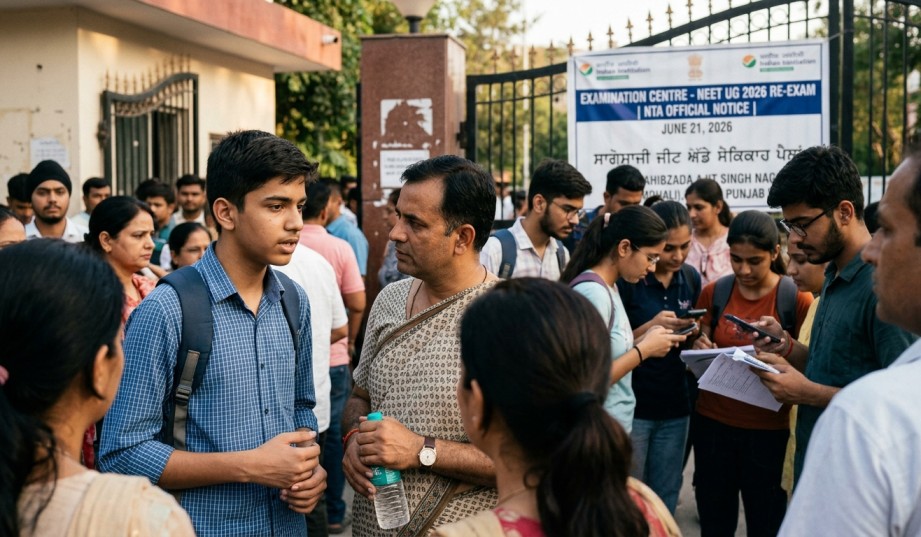
NEET UG 2026 answer key and paper analysis
NEET Re-Test 2026 Begins: 20 Lakh Students Hope There Is No Paper Leak Again
This video provides a first-hand look at the atmosphere outside exam centers and the security measures taken for the re-test.