
In the fast-paced world of commercial food service, consistency and speed are the cornerstones of success. Whether you are managing a bustling restaurant, a large hotel, or a high-capacity canteen, the demand for fresh, hot rotis is constant. However, traditional hand-rolling methods are not only time-consuming but also labor-intensive. Enter the game-changer: the automatic chapati making machine.
By integrating advanced technology into your food production line, you can transform how you handle one of the most fundamental staples of the Indian diet. In this post, we explore why investing in an industrial-grade chapati maker is the smartest move for your business growth.
The Challenge of Manual Production
North Indian food is incomplete without chapati, yet the process of preparing it at scale is arduous. For businesses, relying solely on human labor leads to several challenges:
-
Inconsistent Quality: Achieving the perfect circle and uniform thickness by hand is difficult, leading to variations in every batch.
-
High Labor Costs: A significant chunk of your manpower is tied up in the kitchen, often taking time away from other crucial culinary tasks.
-
Scalability Issues: During social occasions, peak hours, or large events, meeting the high volume of orders can quickly overwhelm a kitchen staff.
How an Automatic Chapati Making Machine Works
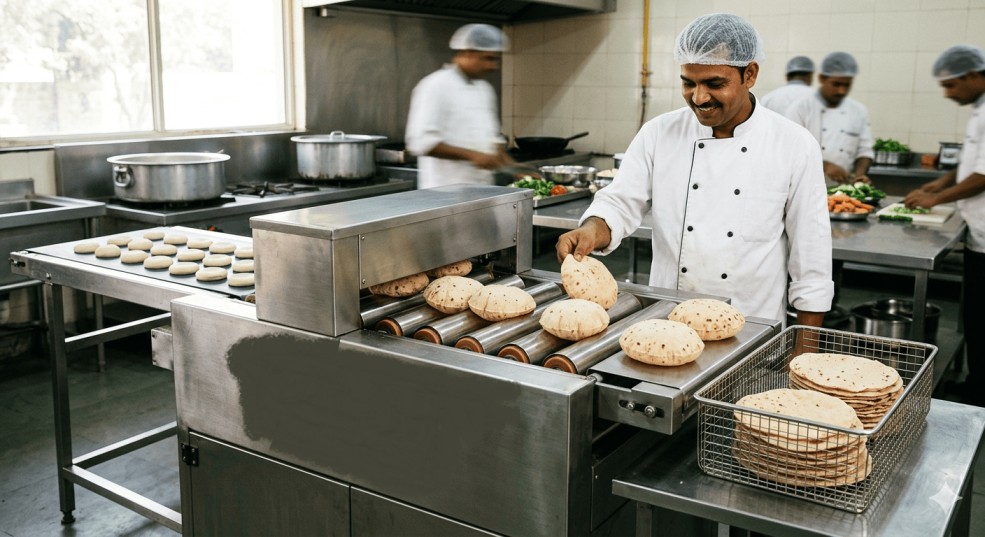
The concept is simple yet brilliantly effective: precision engineering designed for high throughput. With a modern automatic chapati making machine, the complexity of the process is stripped away.
Users simply feed the dough into the machine. From there, the technology takes over, automating the entire process:
-
Dough Handling: The machine processes the flour into the perfect consistency.
-
Precision Rolling: It flattens the dough into uniform, perfect circles with an even surface structure.
-
High-Speed Output: You can produce a large number of chapatis in a fraction of the time it takes manual laborers.
Key Benefits for Your Business
1. Unmatched Consistency and Precision
When you serve customers, you want to ensure the quality is identical every single time. An automatic machine provides uniformity in size, shape, and thickness. This means every customer receives a perfect, soft roti, enhancing your reputation and customer satisfaction.
2. Significant Time and Labor Savings
By automating the most repetitive part of the cooking process, you free up your kitchen staff to focus on more specialized culinary duties. This shift allows you to handle higher order volumes without necessarily increasing your headcount.
3. Increased Production Capacity
Whether you are catering for a large wedding or supplying a corporate canteen, speed is essential. These machines are designed for high-speed operation, allowing you to scale your production up to meet even the most demanding peak-hour requirements.
4. Hygienic Production
Automated systems minimize human contact with the food during the preparation and rolling stage. This adherence to hygiene standards is critical for modern commercial kitchens aiming to maintain the highest levels of safety and quality assurance.
Choosing the Right Machine for Your Needs
Not every kitchen has the same requirements. That is why industry-leading manufacturers, like Kalsi Machine Tools, offer a wide range of solutions tailored to specific business needs, including:
-
Peda Type Chapati Making Machines: Ideal for operations needing specific dough portion control.
-
Rolling Type Machines: Focused on achieving the perfect, traditional round shape.
-
Fully Automatic Roti Makers: Designed for hands-off, high-volume production.
When selecting your equipment, consider your daily output requirements, the space available in your kitchen, and your budget. Investing in a machine built with durable, high-grade materials ensures longevity and a better return on investment.
Conclusion: Take the Leap Toward Efficiency
The transition from manual to automated food production is a major milestone for any commercial food business. By adopting an automatic chapati making machine, you are not just buying a piece of equipment; you are investing in the future efficiency, consistency, and profitability of your kitchen.
Ready to take your kitchen operations to the next level? Explore professional, high-performance machines designed to handle the rigors of commercial use and see how precision engineering can transform your workflow.
Contact Information:
-
Company: Kalsi Machine Tools
-
Address: Phase 9, Shed No 232, Industrial Area, SAS Nagar, Mohali, Punjab, 160062, India
-
Phone: 9988870713
-
Website: www.kalsichapatimachine.com