
In today’s data-driven corporate landscape, companies rely heavily on skilled professionals to interpret complex data, streamline operations, and drive strategic decision-making. If you are looking to launch a high-growth, future-proof career, learning how to become a business analyst is one of the most rewarding paths you can take.
Whether you are a recent graduate, an IT professional seeking a transition, or coming from a non-technical background, breaking into business analysis is entirely achievable with the right guidance, practical tools, and real-world project experience.
In this comprehensive guide, we will walk you through what a Business Analyst does, the essential skills and tools you need to master, and how specialized training can fast-track your career.
What Does a Business Analyst Do?
A Business Analyst (BA) serves as the critical bridge between business stakeholders and technical development teams. BAs identify organizational problems, analyze data, design practical solutions, and ensure that software or business process updates align with overall strategic goals.
Key Responsibilities of a Business Analyst:
-
Requirement Gathering: Interviewing stakeholders and documenting functional and non-functional requirements.
-
Data Analysis: Interpreting data sets to discover trends, risks, and efficiency opportunities.
-
Process Mapping: Creating visual workflows and process diagrams to depict current and future business states.
-
Solution Design & Validation: Partnering with developers and testers to ensure built solutions meet business needs.
-
Stakeholder Communication: Presenting findings, recommendations, and dashboards clearly to decision-makers.
Key Skills and Tools Required to Become a Business Analyst
To succeed in a modern Business Analyst role, you need a blend of technical capability, data handling skills, and business communication acumen. Here are the core competencies every aspiring BA must master:
1. Advanced Microsoft Excel
Excel remains the foundational tool for data manipulation, financial modeling, and quick reporting. BAs use advanced functions such as VLOOKUP/XLOOKUP, Pivot Tables, and conditional formatting to clean and analyze datasets daily.
2. SQL (Structured Query Language)
Data lives in databases, and SQL is the language used to extract it. Knowing how to write SELECT queries, JOIN tables, filter records, and perform aggregations allows you to query enterprise databases independently without relying on IT support.
3. Business Intelligence & Visualization (Power BI)
Raw data needs to tell a compelling visual story. Power BI allows analysts to transform complex datasets into interactive, real-time dashboards that executive leadership can easily digest to make data-driven decisions.
4. Agile & SDLC Methodologies
Understanding the Software Development Life Cycle (SDLC), particularly Agile and Scrum frameworks, is essential. BAs write user stories, participate in sprint planning, and maintain product backlogs alongside project managers and developers.
5. Soft Skills & Problem Solving
Technical skills get you the interview, but soft skills get you the job. Critical thinking, active listening, negotiation, and clear technical writing (writing Business Requirement Documents or BRDs) are essential for managing varied stakeholder expectations.
Step-by-Step Roadmap: How to Become a Business Analyst
Transitioning into a Business Analyst role without prior experience may seem daunting, but following a structured roadmap will ensure your success:
Step 1: Master Core Business Analysis Concepts
Begin by understanding standard business analysis frameworks, requirement gathering techniques, and standard documentation formats (such as BRD, FRD, and User Stories).
Step 2: Build Technical Proficiency in Tools
Focus on learning Excel, SQL, and Power BI hands-on. Practice retrieving data, transforming messy spreadsheets, and building visual dashboards from scratch.
Step 3: Gain Practical Experience Through Live Projects
Theoretical knowledge isn’t enough for today’s job market. Employers hire candidates who have applied these tools to real business scenarios, such as mapping customer journeys, optimizing supply chains, or performing sales trend analyses.
Step 4: Prepare a High-Impact Resume & Portfolio
Tailor your resume to highlight analytical problem-solving, project tools, and quantitative achievements. Create a portfolio displaying your Power BI dashboards and SQL project code.
Step 5: Practice Mock Interviews & Land Your First Role
Perform behavioral and technical mock interviews to confidently answer domain-specific questions, explain your project methodologies, and showcase your problem-solving process.
Accelerated Career Path: Business Analyst Training at Envision Learning Academy
If you want to skip the trial-and-error of self-study and gain job-ready confidence fast, structured, expert-led training is the most effective investment you can make.
At Envision Learning Academy, our comprehensive Business Analyst Training Program is engineered specifically to take you from foundational knowledge to career success with personalized mentorship every step of the way.
Why Choose Envision Learning Academy?
-
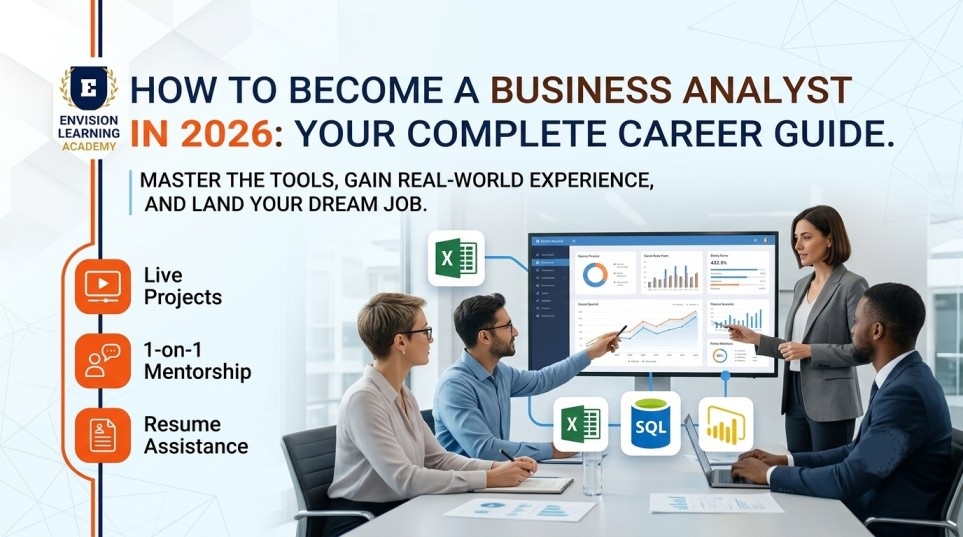
Hands-on Tool Mastery: Master Microsoft Excel, SQL, and Power BI through practical exercises.
-
Real-World Live Projects: Work on actual business scenarios and build an impressive portfolio that stands out to hiring managers.
-
1-on-1 Personalized Counseling: Receive tailored career advice and direct mentorship throughout your learning journey.
-
Weekend Mock Interviews: Practice real interview scenarios every weekend to build confidence and polish your technical answers.
-
Resume Preparation & Optimization: Get professional assistance drafting an ATS-optimized resume tailored for BA roles.
-
Flexible Learning: All training sessions are recorded and shared, allowing you to review complex topics at your own pace.
-
On-Job & Placement Support: We extend support beyond training to assist you with job applications, placement opportunities, and initial on-the-job guidance.
Frequently Asked Questions (FAQs)
Can I become a Business Analyst without an IT or coding background?
Yes! Many successful Business Analysts come from backgrounds in business administration, finance, sales, customer support, or humanities. The primary requirement is strong logical reasoning, willingness to learn tools like SQL and Excel, and effective communication.
How long does it take to learn how to become a Business Analyst?
With a focused, structured training program, you can acquire core technical skills, complete live projects, and prepare for job interviews within 8 to 12 weeks of dedicated study.
Is Business Analysis a good career choice in 2026?
Absolutely. As businesses across industries—including finance, healthcare, e-commerce, and technology—continue digital transformation initiatives, the demand for professionals who can bridge the gap between business needs and technological solutions remains at an all-time high.
Take the Next Step in Your Professional Journey Today
Don’t leave your career progression to chance. Join the upcoming batch at Envision Learning Academy and acquire the exact skills, project experience, and job search support needed to thrive as a Business Analyst.
New Batch Starting August 29, 2026! Limited seats available to ensure small class sizes and personalized attention.
Get in Touch with Us:
-
Phone: 647-642-7595
-
Website: www.EnvisionLearning.ca
-
Location: Envision Learning Academy