
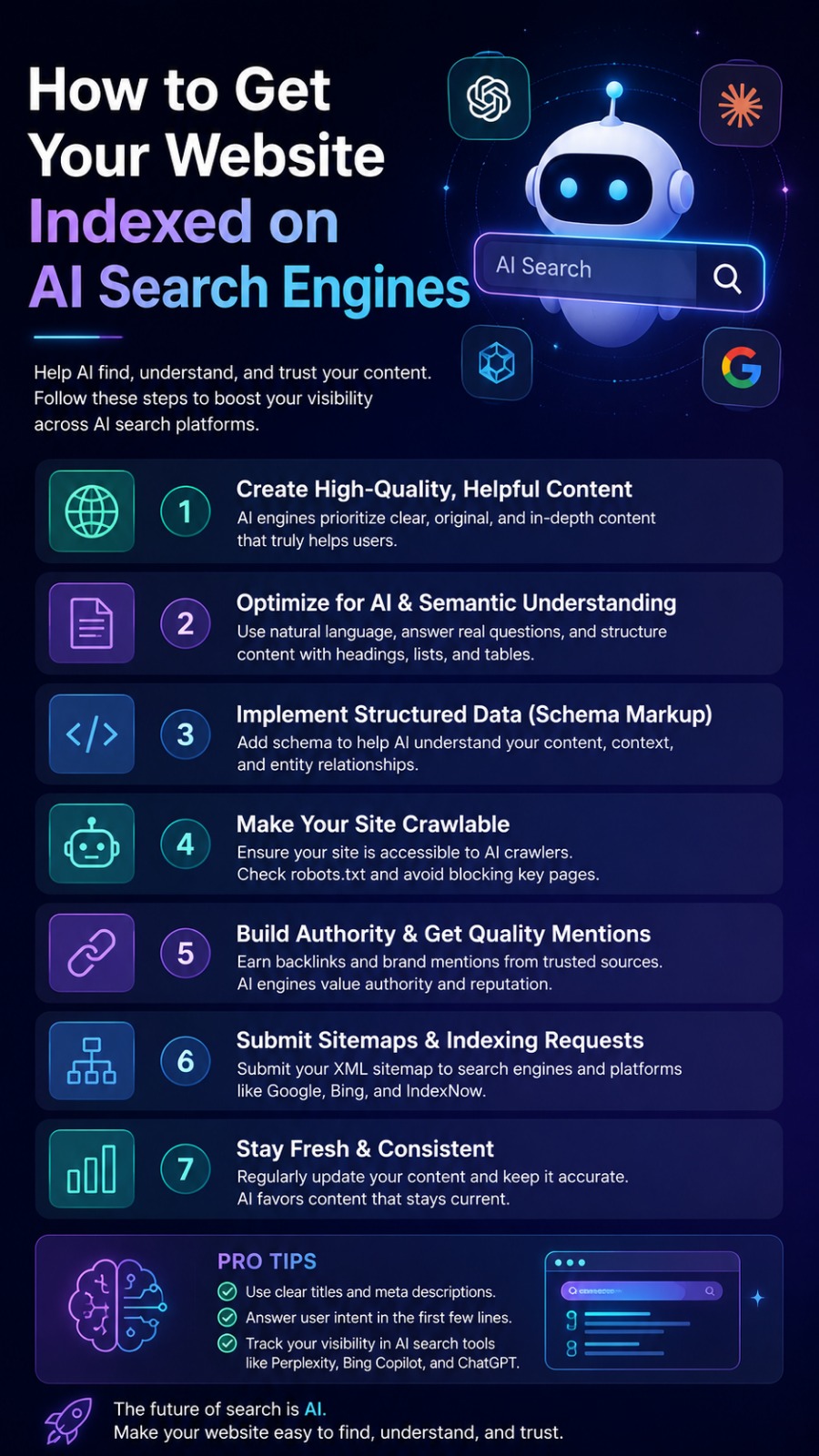
In the rapidly evolving digital ecosystem of 2026, the way users find information is undergoing a fundamental shift. Search is no longer confined to the traditional “ten blue links” of conventional search engines. Instead, conversational AI platforms like Perplexity, ChatGPT, and Bing Copilot are becoming the primary gateways for discovery. For a digital-forward brand like windowit.in, understanding how to get your website indexed on AI search engines is no longer optional—it is a critical necessity for maintaining competitive advantage and organic reach.
Unlike traditional crawlers that prioritize keyword density and backlink volume, AI search engines leverage Large Language Models (LLMs) to synthesize data, extract entities, and answer user queries with context-aware precision. To stay visible, you must pivot your strategy from “writing for bots” to “structuring for intelligence.”
The Fundamental Shift: Why AI Search Engines Are Different
Traditional search engines index pages by mapping keywords to content. AI search engines, however, process the “semantic meaning” of your site. They seek to understand the intent behind your content and whether it provides a direct, trustworthy answer to a user’s prompt.
When you learn how to get your website indexed on AI search engines, you are essentially training your brand’s digital footprint to be “AI-native.” This means focusing on accuracy, structured data, and clarity so that when an AI engine searches for information related to your niche, windowit.in is the source it cites.
7 Core Pillars to Master AI Search Visibility
To ensure your content is not just indexed but preferred by AI systems, you must implement these seven strategic pillars.
1. Creating High-Quality, Helpful Content
AI models are trained to prioritize content that offers distinct value. If your content is generic or thin, AI models will overlook it in favor of deeper, more authoritative resources. At windowit.in, we prioritize long-form, in-depth articles that answer the specific questions our audience is asking.
2. Optimizing for AI and Semantic Understanding
Semantic search is the backbone of modern AI. You must use natural language that humans actually use when asking questions. Avoid keyword stuffing; instead, focus on topical clusters. By organizing your content with clear H1 and H2 headers, you make it significantly easier for AI to map the hierarchy and relevance of your information.
3. Implementing Structured Data (Schema Markup)
Structured data is the bridge between human-readable content and machine-understandable data. By implementing proper Schema Markup, you explicitly tell the AI what your page is about—whether it’s a product review, an FAQ, or a technical guide. This context is what allows an AI to confidently include your content in its synthesis of information.
4. Making Your Site Crawlable
Technical debt can kill your AI visibility. If your site has a poorly configured robots.txt file, or if your server response times are slow, you are essentially closing the door on AI crawlers. Regularly audit your technical setup to ensure that your most critical, high-value pages are open and accessible to the indexing bots that power modern AI search.
5. Building Authority and Quality Mentions
Authority signals remain vital, but the definition of authority is changing. AI engines do not just look at the number of backlinks; they evaluate the quality and context of those mentions. Being featured in respected industry publications and earning genuine brand mentions helps signal to AI engines that windowit.in is a trusted entity in the digital space.
6. Submitting Sitemaps and Indexing Requests
While you want your site to be crawled naturally, you should not rely on that alone. Proactively submit your XML sitemaps to all major search platforms, including those that support IndexNow. This proactive stance ensures that your latest, most relevant content is indexed as quickly as possible.
7. Staying Fresh and Consistent
The AI search environment is dynamic. Algorithms are constantly retrained on the latest data. If your content is outdated, AI will treat it as unreliable. Regularly updating your content with fresh statistics, current industry insights, and new formatting keeps windowit.in at the top of the AI’s “citation list.”
Advanced Strategies for AI Dominance
Beyond the basics, how to get your website indexed on AI search engines requires a proactive approach to your visibility. Here are the pro tips we use at windowit.in:
-
Front-Load Your Answers: AI engines often pull the first few sentences of an article to generate a summary. Answer the core user query in the first paragraph to ensure your site is the one cited in the generated answer.
-
Use Comparison Tables: AI models love structured data. Converting technical information into tables often increases the chances of your site being used to populate a comparison summary in an AI search result.
-
Track Your Citations: Use specialized tools to monitor how often your site is cited by Perplexity, Bing Copilot, or ChatGPT. If you see a dip, re-evaluate your content for accuracy and freshness.
The Future of Search Is AI-Driven
We are in the midst of a technological revolution. As AI continues to integrate into browsers, operating systems, and mobile devices, the barrier between “search” and “answer” will continue to dissolve. By learning how to get your website indexed on AI search engines today, you are future-proofing your business.
At windowit.in, we believe that the websites that succeed in this era will be those that provide clear, structured, and profoundly helpful information. If you commit to these steps, your content will not only be indexed—it will become a foundational part of the information that AI provides to users worldwide.
Frequently Asked Questions (FAQ)
1. How do I know if I’m learning how to get your website indexed on AI search engines correctly? The best way to verify is to perform specific searches on platforms like Perplexity or ChatGPT. If your site is being cited as a source for your industry keywords, your strategy is working.
2. Is there a specific meta tag for AI indexing? No, there is no single “AI tag.” Instead, you must rely on a combination of high-quality content, structured schema, and a technically clean, crawlable website structure.
3. Does windowit.in prioritize AI indexing over traditional Google SEO? We view them as two sides of the same coin. A site that is structured for AI is often inherently optimized for traditional search as well, because both prioritize clarity, speed, and user value.
4. How does FAQ content help with AI indexing? FAQ sections provide direct “Question and Answer” formats that AI engines are specifically trained to identify. This makes your content highly likely to be used in generative responses.
5. Should I change my focus from keywords to topics? Yes. Modern AI search engines are significantly more concerned with “topical authority” than individual keywords. Focus on creating comprehensive hubs of information on core topics rather than single-keyword articles.