
In 2026, the digital landscape has shifted dramatically. With the rise of advanced generative AI, the threats facing your personal and professional data have evolved. Cybercriminals are no longer relying on poorly written spam emails to compromise your information; they are leveraging artificial intelligence to craft hyper-personalized, context-aware, and highly convincing scams. For many users and businesses, the most pressing question today is: how to protect Gmail account from AI phishing attacks?
At WindowIT, we believe that proactive security is the only way to stay ahead of these evolving threats. In this guide, we will explore why these attacks are becoming so common, what makes them dangerous, and exactly how you can harden your defenses.
The Evolution of Phishing: Why AI Changes the Game
Historically, phishing attempts were easy to spot. They were often filled with grammatical errors, generic greetings, and suspicious links that clearly didn’t lead to a legitimate login page. Today, AI has completely erased these “tells.”
Attackers now use Large Language Models (LLMs) to perform automated reconnaissance. By scraping public profiles, social media, and previous breach data, AI tools can create a detailed profile of their target. When they send a phishing email, it doesn’t just look like a standard alert—it references your recent projects, mentions your coworkers by name, and perfectly mimics the tone of a professional communication you would expect to receive.
Because AI can generate thousands of these unique, hyper-personalized messages simultaneously, the volume of attacks has surged. Understanding how to protect Gmail account from AI phishing attacks is no longer a luxury; it is a necessity for anyone with a digital presence.
The Dangers of AI-Enhanced Social Engineering
The primary goal of these attackers is to bypass your skepticism. By making an email look and sound like it originated from a trusted source—or even from a colleague—hackers increase the likelihood that you will click a malicious link or provide sensitive credentials.
Beyond text, we are seeing a rise in “vishing” (voice phishing) and deepfake technology. Attackers can clone the voices of executives or support staff to conduct real-time calls that feel incredibly authentic. If an attacker can successfully mimic a trusted entity, traditional defenses may fall short. This is why learning how to protect Gmail account from AI phishing attacks requires a multi-layered security approach that goes beyond simple password management.
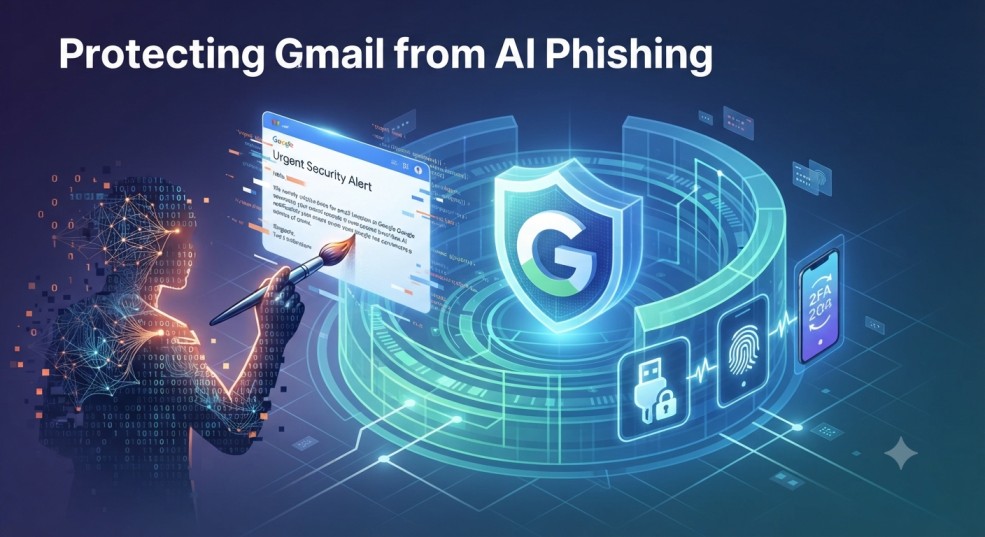
Step-by-Step: How to Protect Gmail Account from AI Phishing Attacks
At WindowIT, we recommend implementing these five critical strategies to ensure your account remains impenetrable to even the most sophisticated AI-driven campaigns.
1. Enforce Multi-Factor Authentication (MFA)
Passwords alone are no longer enough. Even if an AI-driven attack manages to trick you into revealing your password, MFA provides a critical second barrier. For the highest level of security, prioritize using a physical security key (like a YubiKey) or an app-based authenticator over SMS-based codes, which can be intercepted.
2. Utilize Passkeys for Seamless Security
Google now supports passkeys, which allow you to sign in using your device’s biometric authentication (fingerprint, face scan, or screen lock). Unlike passwords, passkeys cannot be phished or shared, as they are cryptographically linked to your device. Moving to passkeys is one of the most effective ways to learn how to protect Gmail account from AI phishing attacks.
3. Perform Regular Security Checkups
Google provides a built-in “Security Checkup” tool that assesses your account’s health. This feature identifies:
-
Unused third-party apps that have permission to access your data.
-
Leaked passwords that may have been compromised in other site breaches.
-
Outdated recovery information that could prevent you from regaining access to your account.
4. Practice “Zero-Trust” Email Habits
Even if an email looks perfect, maintain a healthy level of suspicion. Never click on “Urgent” links or download unexpected attachments. If you receive an email claiming to be from a service or a known contact, navigate to the official website or contact the person through a different, verified communication channel before taking any action.
5. Enroll in the Advanced Protection Program
If you are at high risk—such as a business leader, journalist, or someone handling sensitive data—the Google Advanced Protection Program is the gold standard. It enforces the strictest security settings, including the mandatory use of physical security keys and enhanced scanning for malicious downloads.
Frequently Asked Questions (FAQ)
Q: Can AI really mimic my boss’s writing style? A: Yes. Modern AI models can analyze publicly available content like LinkedIn posts, company blogs, or past email patterns to replicate the specific tone and vocabulary of an individual.
Q: Is 2-Step Verification enough to stop these attacks? A: While 2-Step Verification is significantly safer than using a password alone, modern “MFA fatigue” or “session hijacking” attacks can sometimes bypass it. This is why using physical security keys or passkeys is recommended.
Q: Why does WindowIT recommend physical security keys? A: Physical security keys are immune to phishing. Because they require a physical presence to authenticate, an attacker cannot “trick” a bot or a phishing link into capturing a digital code that works.
Q: What should I do if I think I clicked a phishing link? A: Immediately change your Google account password and revoke access for any third-party apps in your security settings. If you use a password manager, ensure that password is changed everywhere else it was used.
Q: How often should I run a Security Checkup? A: We at WindowIT suggest performing a Security Checkup at least once every quarter or immediately after receiving any suspicious security alerts.
Stay ahead of cyber threats with WindowIT. Your security is our priority. If you need professional assistance in securing your business or personal accounts, contact our team today.