
The landscape of digital payments is undergoing a radical paradigm shift. Gone are the days when manual data entry and explicit two-factor authentication were required for every single online checkout. As artificial intelligence transitions from a novelty tool into autonomous digital coworkers, financial ecosystems worldwide are racing to adapt. In India, where real-time transactions scale to astronomical heights month after month, the National Payments Corporation of India (NPCI) is taking a groundbreaking step forward.
By pioneering a Unified Agentic Protocol backed by a centralized AI-agent registry, India’s digital public infrastructure is preparing for an era where software assistants execute routine financial decisions safely on behalf of users. At Munimigiri we closely track these tectonic shifts in financial technology to help businesses, developers, and everyday users understand how autonomous commerce will impact daily operations. Let’s break down how this protocol works, why it matters, and how it will reshape the future of digital commerce.
What is the Unified Agentic Protocol and Why Does It Matter?
As AI systems evolve, they are no longer restricted to chatting, drafting emails, or analyzing charts. Modern AI architectures can interpret natural language instructions, compare competitive product pricing, select appropriate vendors, and execute transactions from end to end. However, giving software the authorization to spend real money introduces immense security, liability, and verification challenges.
Enter the Unified Agentic Protocol. Designed as a structural framework by the NPCI, this upcoming architecture introduces a national vetting system to identify, screen, and monitor autonomous software agents operating over the Unified Payments Interface (UPI).
Core Pillars of the Protocol:
-
Software Authentication: Creating a verifiable cryptographic or registry-backed identity for every AI assistant.
-
Operator Accountability: Explicitly mapping which entity or user owns and operates the executing software agent.
-
Real-Time Risk Assessment: Empowering banks and payment gateways to immediately flag abnormal or unauthorized transactional behavior.
Inside the NPCI AI-Agent Registry: How It Works
Scaling agentic commerce safely requires a trusted single source of truth. The proposed AI-agent registry acts as an official ledger where approved software agents must register before they can initiate transactions on India’s financial grid.
+------------------------------------------------------------+
|                      User / Consumer                       |
+------------------------------------------------------------+
                              |
                              | Grants Conditional Authority
                              v
+------------------------------------------------------------+
|                AI-Agent Registry Verification              |
|        (Authenticated via Unified Agentic Protocol)        |
+------------------------------------------------------------+
                              |
                              | Validated Software Identity
                              v
+------------------------------------------------------------+
|             UPI Real-Time Processing Network               |
|            (Executes Routine / Low-Value Pay)              |
+------------------------------------------------------------+
Phased Rollout Strategy
Rather than opening the floodgates to complete financial autonomy all at once, the rollout is structured to prioritize security:
-
Low-Value Routine Purchases: Initial deployments will focus on low-risk, high-frequency transactions such as grocery orders, utility bill settlements, and routine household restocks.
-
Conditional and Complex Actions: Over time, the framework will scale to support more advanced automated directives, such as executing investments when market thresholds are crossed or purchasing items when specific price drops occur.
At Munimigiri, we believe this phased approach is vital for building institutional trust and ensuring that consumers feel secure delegating financial tasks to software loops.
Market Implications: Fintech, Merchants, and Consumers
The integration of agentic capabilities into a massive real-time network like UPI creates ripple effects across the entire financial ecosystem.
-
For Fintech Innovators: Major players—including firms rolling out action-taking assistant tools for merchants—are adapting their APIs to interface smoothly with upcoming protocol standards. Developers must build rigid safety guardrails, clear spending limits, and instant permission-revocation options into their tools.
-
For Merchants: Online sellers will need to optimize their digital storefronts not just for human browsing, but for machine readability. When an AI agent evaluates options, clear product metadata, transparent pricing, and structured APIs become critical for capturing automated sales.
-
For Everyday Users: The friction of manual micro-payments will disappear. Imagine your smart assistant automatically restocking your pantry items when supplies run low, negotiating the best delivery windows, and completing secure UPI checkouts within pre-approved budget boundaries.
Frequently Asked Questions
1. What is the Unified Agentic Protocol?
The Unified Agentic Protocol is an upcoming framework developed by the NPCI to establish standardized rules, security controls, and verification registries for AI agents handling digital payments.
2. How will the AI-agent registry protect users against fraud?
The registry records verified software identities and maps them directly to their operators. This allows banks and payment providers to distinguish legitimate automated requests from malicious software, enabling real-time risk mitigation and swift permission revocation.
3. Will AI agents have unlimited access to my bank account?
No. Agentic protocols are designed around strict user-defined limits, including spending caps, narrow scope permissions, and easy revocation controls tailored specifically for routine or conditional tasks.
4. When will agentic payments become widely available?
While initial frameworks and registries are actively under development and testing, early implementations are expected to target low-value transactions like groceries before expanding into complex financial workflows.
Conclusion
The convergence of artificial intelligence and real-time payment rails marks a defining chapter in modern financial technology. Through visionary initiatives like the Unified Agentic Protocol and structured AI-agent registries, India is setting a global benchmark for how digital public infrastructure can safely embrace autonomous commerce.
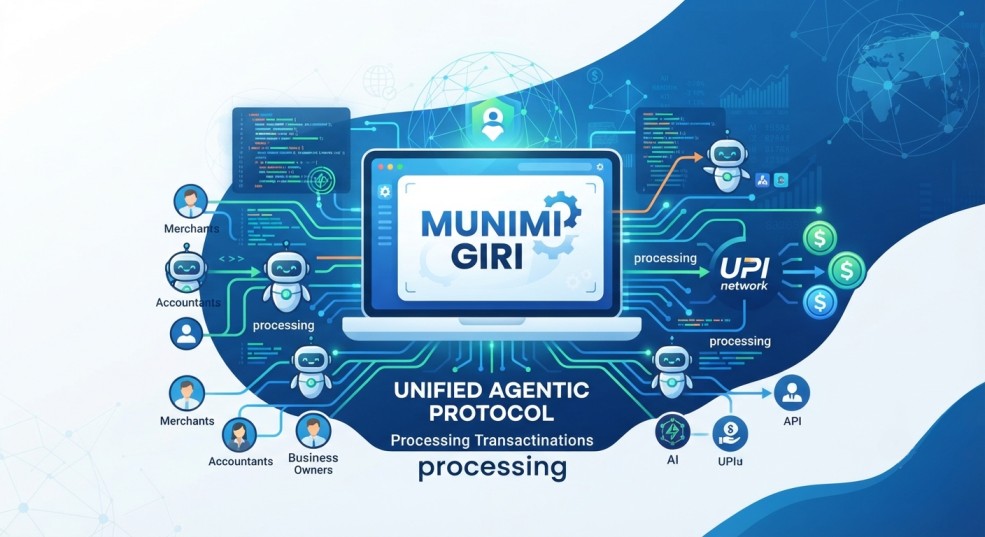
Navigating this transition requires staying informed and agile. Stay connected with Munimigiri as we continue to break down the latest innovations shaping the future of digital transactions, enterprise tech, and secure automation.