
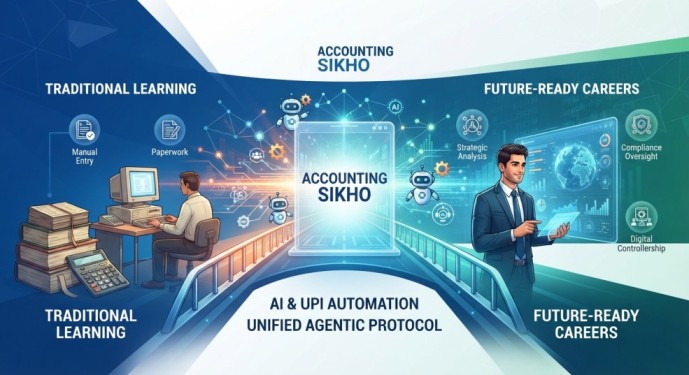
The world of finance and corporate accounting is changing faster than ever. For decades, the backbone of an accountant’s day-to-day routine consisted of manual journal entries, processing ledger sheets, double-checking bank statements, and reconciling transaction records item by item. Today, artificial intelligence and real-time payment innovations are rewriting the rulebook. With platforms like the National Payments Corporation of India (NPCI) rolling out groundbreaking frameworks like the Unified Agentic Protocol and AI-agent registries to automate micro-transactions and digital workflows, the role of the modern accountant is evolving. Routine data entry is rapidly disappearing, paving the way for strategic financial controllership, advisory services, and digital compliance management.
At Accounting Sikho, we closely monitor these technological transformations. Our mission is to bridge the gap between traditional bookkeeping education and the dynamic requirements of today’s automated digital economy. Let’s explore how these tech shifts are redefining accounting careers and what practical skills professionals need to stay ahead.
From Manual Bookkeeping to Autonomous Digital Systems
The introduction of automated payment technologies and machine learning models means businesses can process high volumes of financial data in milliseconds.
-
The Rise of Smart Workflows: Automated agents are increasingly taking over repetitive processes such as invoice generation, vendor payments, and preliminary bank reconciliations.
-
The Shift in Human Responsibilities: Instead of spending hours matching line items, contemporary finance professionals focus on anomaly detection, tax optimization, system auditing, and financial strategy.
+------------------------------------------------------------+
|                Traditional Accounting                      |
|       (Manual Data Entry, Ledger Matching, Paper Work)     |
+------------------------------------------------------------+
                              |
                              | Technological Evolution
                              v
+------------------------------------------------------------+
|                  Modern AI-Driven Finance                  |
|     (Automated Workflows, Strategy, Compliance Oversight)  |
+------------------------------------------------------------+
Why Practical Skill Development Matters More Than Ever
As software takes over routine tasks, employers no longer value professionals who only know how to punch numbers into software. Modern corporate environments demand candidates who understand the logic behind the transactions, possess hands-on mastery of tools like Tally Prime and BUSY, and know how to navigate GST, TDS/TCS, and digital compliance frameworks seamlessly.
Essential Competencies for Next-Gen Finance Professionals
To thrive in an economy influenced by real-time protocols and automated banking, students and job seekers must upgrade their skillsets across three critical pillars:
-
Advanced Software & Tool Proficiency: Mastery over modern accounting software packages, ERP platforms, and advanced spreadsheet tools is non-negotiable. Professionals must know how to audit data generated by automated systems.
-
Comprehensive Taxation & Compliance Knowledge: Software can execute a transaction, but a human expert is required to interpret complex tax implications. Comprehensive training in Goods and Services Tax (GST), Tax Deducted at Source (TDS), and electronic filings remains vital.
-
Analytical Problem Solving: Understanding how to interpret financial dashboards, manage payroll systems, and resolve compliance discrepancies ensures that accountants remain indispensable assets to any organization.
Frequently Asked Questions
1. How is Artificial Intelligence changing accounting jobs?
Artificial Intelligence automates repetitive tasks like data entry and basic reconciliation, allowing accountants to shift toward higher-value work such as financial analysis, taxation advisory, and business strategy.
2. Do I need a commerce background to learn modern practical accounting?
Not at all. With structured, practical training programs designed from the ground up, even non-commerce graduates and beginners can master core bookkeeping, taxation, and software applications like Tally Prime.
3. What kind of job roles are available after practical accounting training?
Trained professionals can step into roles such as Junior Accountants, Accounts Payable/Receivable Specialists, GST Executives, Tax Assistants, and Corporate Accounting Executives.
Conclusion
The integration of advanced protocols, AI automation, and digital payment frameworks into the corporate sector signals an exciting era for financial professionals. Embracing these changes requires practical, hands-on learning that prepares you for real-world scenarios.
Stay ahead of the curve by building robust, industry-ready capabilities with Accounting Sikho, and position yourself for long-term success in the modern financial landscape.