
Every year during the monsoon season, millions across India and around the globe come together to celebrate Krishna Janmashtami. Homes are adorned with flowers and rangolis, temples light up with devotional chants, and continuous fasting culminates in late-night celebrations. But beyond the lights, music, and festive aura, many people ask: why is Janmashtami celebrated, and what makes this festival so central to Hindu culture?
Janmashtami marks the divine birth of Lord Krishna, the eighth avatar of Lord Vishnu. Far from being a routine anniversary, the day celebrates the ultimate triumph of righteousness over tyranny, hope over darkness, and unconditional devotion.
The Sacred Origin Story: Krishna’s Birth in Mathura
To fully understand the spiritual meaning of Janmashtami, one must look back to ancient Mathura during the reign of King Kansa.
According to sacred scriptures, Kansa was a cruel ruler who spread terror across the region. On the day of his sister Devaki’s marriage to Vasudeva, a heavenly voice prophesied that Devaki’s eighth child would slay Kansa and end his oppressive rule. Terrified for his life, Kansa imprisoned Devaki and Vasudeva in a heavily guarded dungeon, killing their first six children one by one. The seventh child (Balarama) was miraculously transferred to the womb of Rohini.
                  ┌──────────────────────────────────────────┐
                  │    The Miraculous Night of Nakshatra     │
                  └────────────────────┬─────────────────────┘
                                       │
        ┌──────────────────────────────┼──────────────────────────────┐
        ▼                              ▼                              ▼
┌───────────────┐              ┌───────────────┐              ┌───────────────┐
│ Midnight      │              │ Divine        │              │ Safe          │
│ Arrival       │              │ Intervention  │              │ Sanctuary     │
├───────────────┤              ├───────────────┤              ├───────────────┤
│ Born on       │              │ Guards sleep; │              │ Vasudeva      │
│ Ashtami Tithi │              │ prison doors  │              │ carries baby  │
│ in a dark     │              │ unlock        │              │ across Yamuna │
│ dungeon [1.1.8]│              │ magically     │              │ to Gokul      │
└───────────────┘              └───────────────┘              └───────────────┘
On the eighth day (Ashtami) of the dark fortnight (Krishna Paksha) in the month of Bhadrapada, under the Rohini Nakshatra, Lord Krishna took birth at midnight inside the cold prison cell. At that moment, a divine light filled the room, the prison guards fell into a deep sleep, and the heavy chains binding Vasudeva fell away.
Vasudeva placed baby Krishna in a wicker basket on his head and crossed the stormy Yamuna river, protected by the serpent Sheshnag, to reach the peaceful village of Gokul. There, he exchanged Krishna with the newborn daughter of Nanda and Yashoda, ensuring the divine child’s safety.
Core Reasons Why Janmashtami holds Universal Relevance
While the historical story is dramatic, the deeper spiritual symbolism explains why Janmashtami remains a pivotal annual event:
-
Restoration of Dharma (Righteousness): Krishna’s birth embodies the timeless promise of the Bhagavad Gita—that whenever unrighteousness prevails, the divine descends to protect the good and restore balance.
-
Light in Utter Darkness: The birth occurring in a dark cell at midnight symbolizes how truth and spiritual illumination can emerge even during life’s most challenging times.
-
Celebration of Divine Joy (Ananda): Lord Krishna represents love, wisdom, playfulness, and ultimate liberation. Celebrating his arrival brings a spirit of boundless joy and unity into households.
How Janmashtami is Celebrated Across India
The festivities vary across regions, bringing out unique traditions and cultural expressions:
| Region | Primary Tradition | Key Highlights |
| Mathura & Vrindavan | Temple Abhishek & Raas Leela | The birthplace comes alive with grand midnight pujas and dramatic enactments of Krishna’s life. |
| Maharashtra | Dahi Handi | Human pyramids (Govindas) stack high to break curd pots hung above street intersections. |
| Gujarat (Dwarka) | Dwarkadhish Janm-Utsav | Grand temple ceremonies, night-long bhajans, and devotion at Krishna’s ancient kingdom. |
| South India | Footprints & Bhog | Families draw tiny rice-flour footprints leading into their homes, symbolizing baby Krishna entering. |
Key Rituals: Fasting, Midnight Puja, and Bhog
Devotees observe several traditional rituals throughout the day to honor Lord Krishna:
-
Janmashtami Fasting (Vrat): Millions observe a complete or fruit-based (phalahar) fast during the day. Foods like sabudana, buckwheat (kuttu), fruits, and dairy are consumed, avoiding grains and lentils.
-
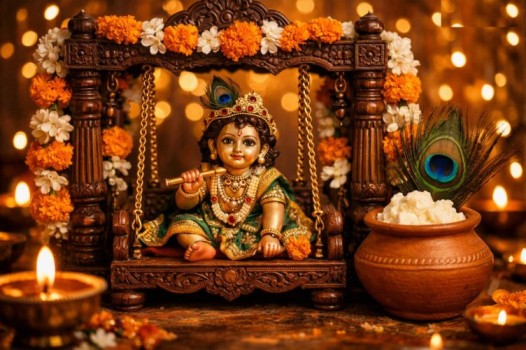
Decorating Laddu Gopal: In homes, small idols of baby Krishna (Laddu Gopal) are placed in decorated swings (jhulas).
-
Nishita Kaal Midnight Puja: Since Krishna was born at midnight, the core ritual occurs during the Nishita Kaal window. The idol receives a holy bath (Abhishek) using Panchamrit (milk, curd, ghee, honey, and sugar), followed by fresh clothes, flowers, and a peacock feather.
-
Offering Makhan & Mishri: Krishna’s legendary love for fresh butter makes Makhan-Mishri and Dhaniya Panjiri the essential holy offerings (bhog).
Frequently Asked Questions (FAQ)
Why is Janmashtami always celebrated at midnight?
Lord Krishna was born at the exact hour of midnight under the Rohini Nakshatra during the dark fortnight. The midnight worship window (Nishita Kaal) honors the exact time of his arrival.
What is the main food offered on Janmashtami?
The primary bhog includes freshly churned white butter (makhan) with sugar crystals (mishri), along with Dhaniya Panjiri (coriander-based prasad) and Panchamrit. Tulsi leaves are added to every offering.
What does Dahi Handi signify?
Dahi Handi mimics young Krishna’s childhood escapades in Gokul, where he and his friends formed human pyramids to reach butter pots hung high from village ceilings.
Can anyone observe the Janmashtami fast?
Yes, anyone can observe the fast. Devotees often choose either a strict fast until midnight or consume water, fruits, and milk-based preparations throughout the day before breaking it after midnight prayers.
Conclusion
Understanding why Janmashtami is celebrated reveals a tradition rich in spiritual depth, moral courage, and pure joy. Whether you observe the day by fasting, swinging baby Krishna’s cradle, or watching local Dahi Handi events, the festival serves as a timeless reminder that light and truth will always conquer darkness.